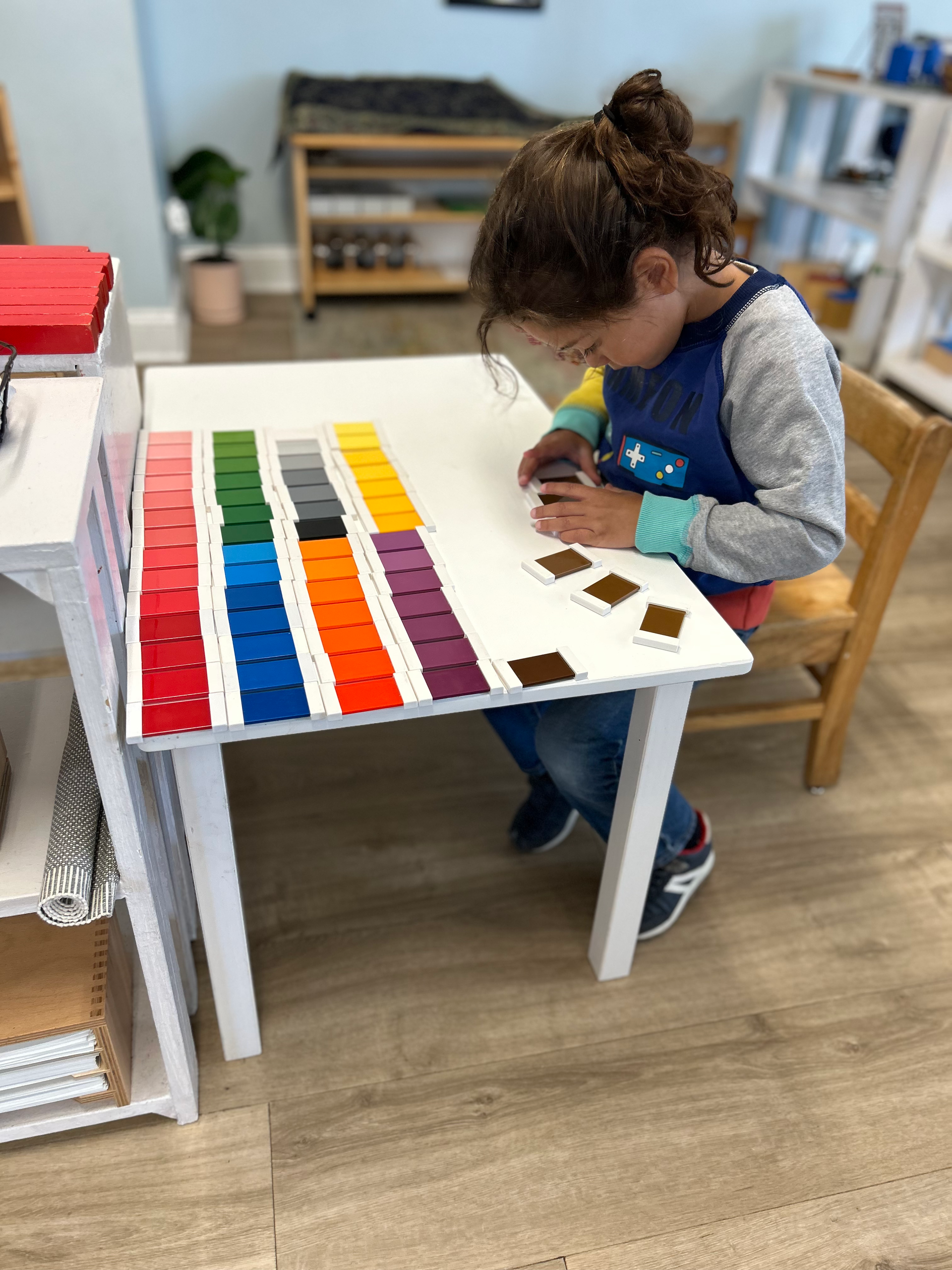
The scene may feel familiar to many of our families. You sit down for dinner at the end of a long day. Your youngest starts tapping their spoon against a bowl, entirely fascinated by the rhythmic sound it makes. Your middle child, entering that expansive age of curiosity, begins asking a rapid-fire series of big questions: “What does it mean to get an education? Why do people go to school? Why are there wars?” Meanwhile, your oldest starts getting frustrated with the other two, wanting everyone to follow directions and keep their place settings in perfect order.
In that chaotic pre-dinner moment, it’s easy for exasperation to take over. As parents, we might sometimes wonder what in the world propels our children to do the things they do. What are they truly seeking when they test boundaries, make a mess, or ask questions we aren't quite prepared to answer?
To find the answer, we look to a foundational pillar of the Montessori philosophy: Innate Human Tendencies.
What are Human Tendencies?
Dr. Maria Montessori recognized that all human beings are born with an innate set of characteristics. We are hard-wired from birth to explore, work, connect, and communicate. We crave order in our surroundings. We imagine possibilities, orient ourselves to new spaces, move our bodies, and constantly wonder about the how and the why.
These human tendencies are unconscious, universal drives. They are the exact biological and psychological tools that allow a child to adapt to their specific time, place, and culture.
When your toddler or Primary child is exploring the noise of a spoon against a bowl, they aren’t trying to aggravate you. They are actively exploring cause and effect, refining their auditory senses, and testing the physical properties of their environment.
How These Drives Manifest at Home and School
When we take a step back and view our children through the lens of these internal drives, our parenting and teaching shifts from frustration to fascination. We can intentionally design our environments to meet these needs productively.
1. The Need for Order and Orientation
Human beings crave order—it provides a vital sense of psychological safety. Think about the subtle anxiety you feel when visiting an unfamiliar home where you don't know whether to keep your shoes on, where to hang your coat, or how to help. Children feel this tenfold.
In our WSMS classrooms, everything has a precise, predictable place. We can mirror this at home by ensuring our children have consistent routines and accessible spaces. Giving them a low hook for their coat, a dedicated shelf for their shoes, or a specific stepstool in the kitchen allows them to orient themselves and participate in the daily rhythm of the family.
2. The Drive for Meaningful Work
Children want to feel significant and purposeful. By offering them opportunities to genuinely contribute to the household—such as setting the table, feeding a pet, gathering laundry, or slicing bananas for breakfast—we satisfy their innate drive to work and perfect their movements. When they participate in these real ways, their internal confidence flourishes.
3. Intellectual Exploration and Imagination
As children transition into the Elementary years, their drive to explore shifts from the physical environment to the intellectual realm. The constant stream of "big questions" about society, justice, history, and the universe stems from a deep human tendency to abstract, calculate, and imagine.
Instead of seeing these questions as a distraction, our Elementary guides use them as a springboard for independent research, encouraging students to test their ideas and discover how the world fits together.
4. Communication and Social Association
We are fundamentally social beings who must learn to collaborate to survive. When an older child tries to rigidly enforce rules on their younger siblings during dinner, they are exploring the human tendency for social order and association. Rather than stepping in with frustration, we can offer light support, helping them find the right words to communicate and connect with their siblings effectively.
Partnering with the Child's Natural Development
At West Suburban Montessori School, our environments and curriculum are intentionally built around these universal human tendencies. We know that if we try to block or suppress these natural drives, we create friction, resistance, and behavioral challenges. But when we recognize, honor, and support them, children thrive.
By understanding what truly propels our children, we can transform a chaotic dinner table into a beautiful laboratory of human development.
We invite you to join us for a classroom observation this school year to see exactly how our prepared environments channel these powerful, innate human tendencies into independent learning, deep focus, and mutual respect.