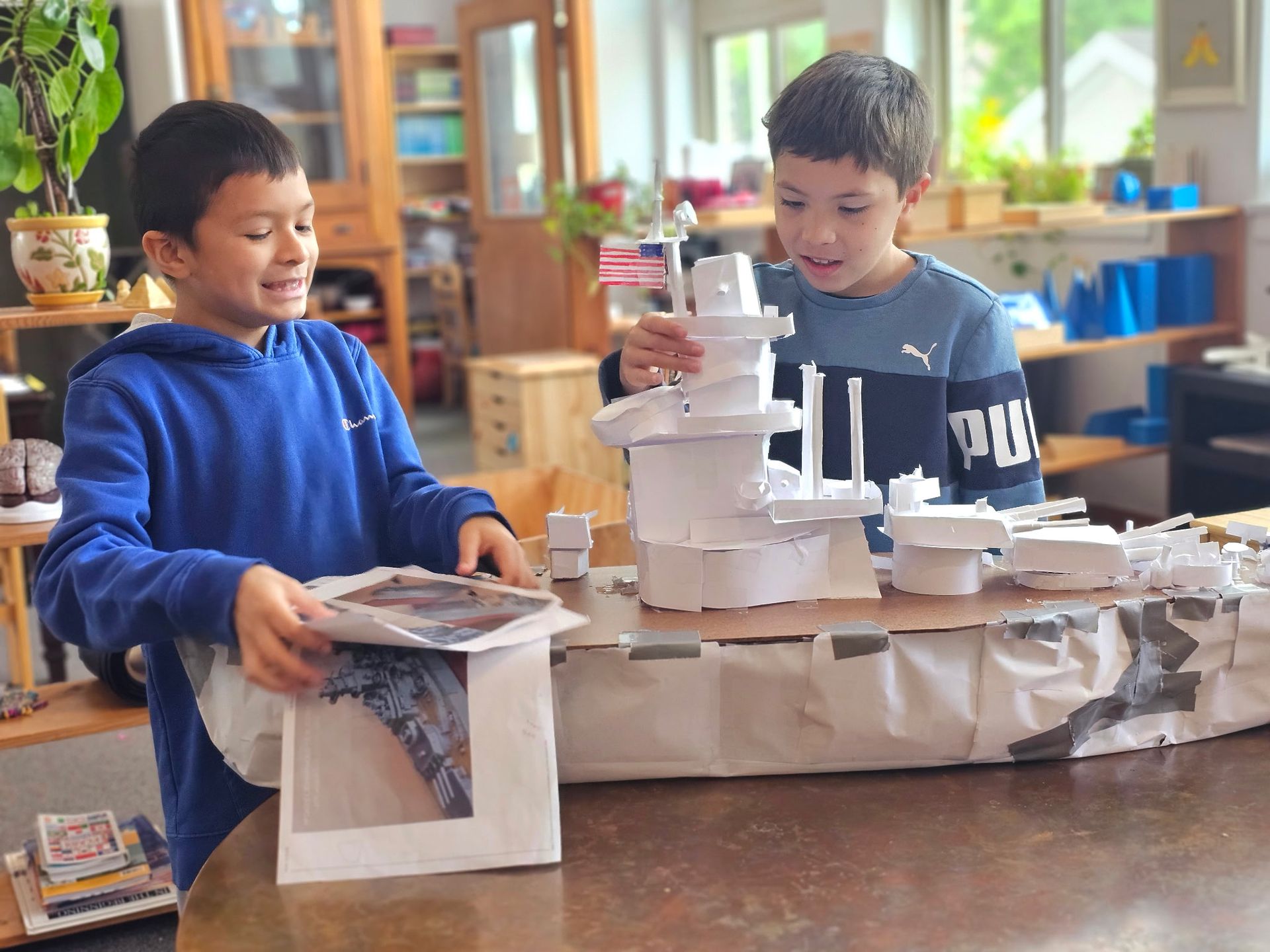
In a Montessori environment, there are two words you will hear us emphasize on a daily basis: grace and courtesy.
While these terms might sound traditional on the surface, in the Montessori context they represent something much deeper than memorized "pleases" and "thank yous." Grace is the ability to move through the world with self-awareness, coordination, and consideration. Courtesy is the outward expression of respect toward others and our environment. Together, grace and courtesy form the bedrock of how we live, work, and grow together as a peaceful school community at West Suburban Montessori School.
How Grace & Courtesy Lessons Work in Primary
In our Primary environments, grace and courtesy are considered an integral part of Practical Life. We devote intentional time to these lessons, offering explicit, step-by-step guidance on everyday social interactions.
Rather than issuing abstract rules, guides offer clear, concrete demonstrations on topics like:
- How to walk carefully around a classmate’s work rug
- How to interrupt an adult or peer politely by placing a gentle hand on their shoulder
- How to offer help to a friend
- How to push in a chair quietly so others don't trip
- How to greet a visitor entering the classroom
These lessons are presented individually or in small groups, often using role-playing and lighthearted modeling.
Crucially, we never give grace and courtesy lessons as a form of public correction or punishment. If a child forgets a grace and courtesy skill during the day, guides make a mental note and offer a fresh, neutral lesson to the child or group at a later time. This preserves the child’s dignity, ensuring they feel safe, respected, and intrinsically motivated to care for their classroom community.
Evolution into Elementary: Navigating Social Dynamics
As children move into Elementary, their social awareness expands dramatically. At this stage, children are deeply focused on peer relationships and learning how to navigate the nuances of friendship.
Grace and courtesy in the Elementary years shift to address these developing social needs. Lessons focus on:
- Communicating directly and respectfully during a disagreement
- Listening to and validating differing perspectives
- Practicing discretion and empathy when a peer makes a mistake or experiences an embarrassing moment
- Welcoming guests, hosting classroom events, and representing our school community during outings and field trips
The Ultimate Goal: Intrinsic Respect
Dr. Maria Montessori emphasized that courtesy should never be a rigid obligation enforced from the outside. Rather, it should flow naturally from a child's genuine desire to connect. As Dr. Montessori wrote:
“…the essential thing is that [the child] should know how to perform these actions of courtesy when his little heart prompts him to do so, as part of a social life which develops naturally from moment to moment.”
Like every other work in our prepared environments, grace and courtesy require practice, repetition, and modeling. Because these experiences are woven into the normal rhythm of our days, children gradually internalize them.
What Grace & Courtesy Looks Like Every Day at WSMS
When you step into our school, you see the quiet, beautiful results of this work everywhere you look:
- A Primary student holding the heavy exterior door open for a classmate carrying a large project.
- Two Elementary students sitting together on a rug, patiently helping each other tie a pair of shoes.
- A child quietly bringing a tissue or a glass of water to a classmate who is feeling sad.
- Students carefully tucking in chairs, carrying trays with two hands, and offering warm greetings to adults and peers in the hallways.
Through grace and courtesy, WSMS children move far beyond basic niceties. They learn to think deeply about their impact on those around them, developing into empathetic, conscious members of a supportive community.
Seeing the Community in Action
We invite you to
sign up for a tour this semester. Watching the quiet acts of grace and courtesy unfold naturally during a work cycle is an inspiring way to witness social and emotional growth in action.