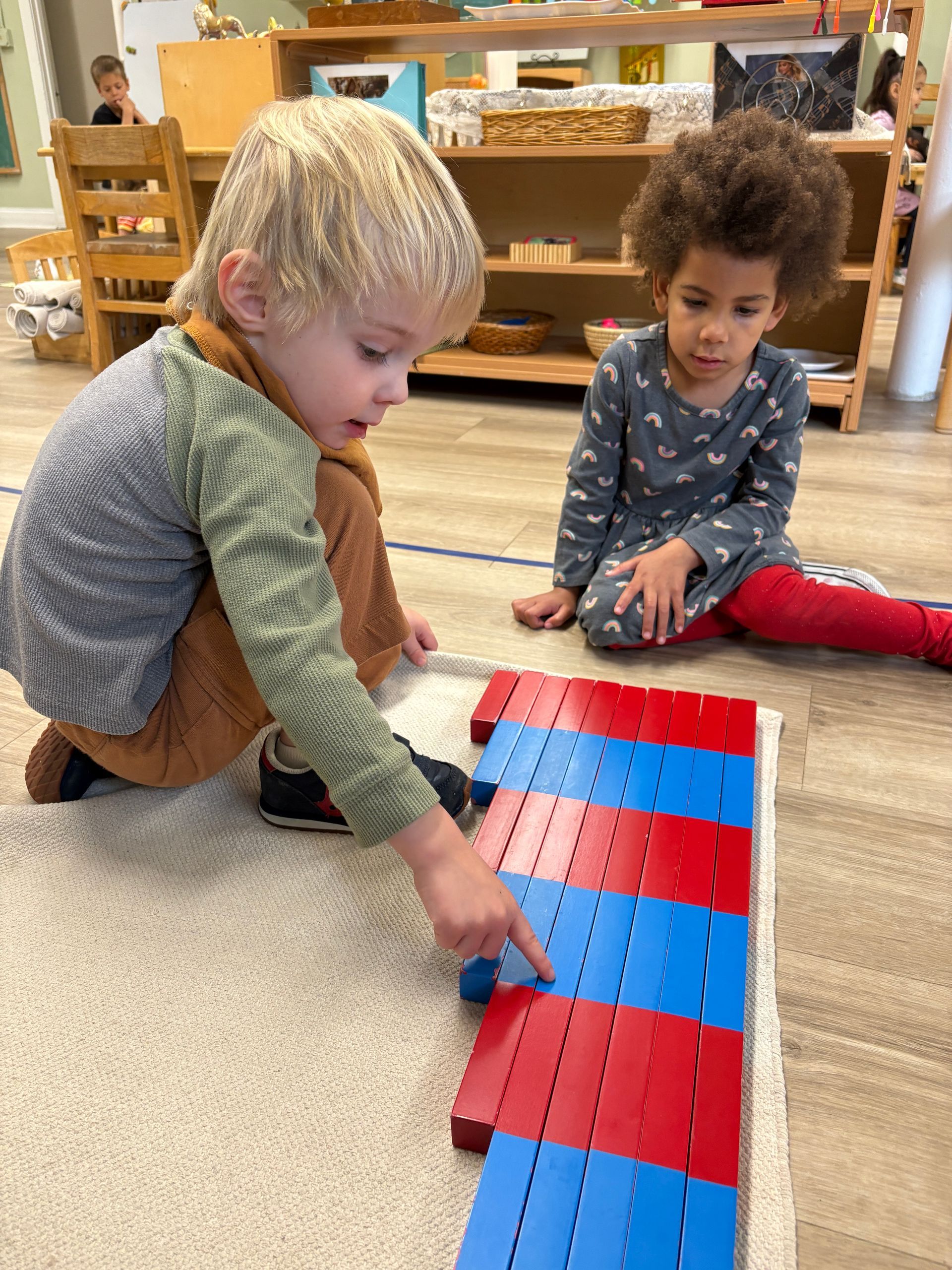
Whether we embrace math or not, humans have an innate tendency to think in patterns, quantify, and make logical connections. Dr. Maria Montessori observed that young children possess this natural propensity—what she termed the "mathematical mind." In our Primary environments at West Suburban Montessori School, we build upon this natural curiosity, offering learning experiences that nurture a deep, intuitive understanding of mathematics from an early age.
Organized into six distinct sequence groups, the mathematical exercises in Primary span from a foundational understanding of the numbers 1 to 10, to working with place value within our decimal system, to internalizing number facts, and even early work with fractions.
1. Numbers 1 to 10
Although learning the numbers 1 to 10 sounds simple, it actually involves integrating several distinct concepts. The beauty of Montessori materials is that they isolate each separate concept so a child’s understanding grows step-by-step. This first group of exercises aims to teach the names, symbols, quantities, and sequence for the numbers 1 through 10.
Children first use the Number Rods, which are color-coded with alternating red and blue sections to designate quantities. As they work with the rods, they solidify the concept of quantity as a single entity while practicing one-to-one correspondence.
The Sandpaper Numbers provide a tactile connection to the symbolic representation of numerals. Once a child can easily identify these symbols, guides help them connect the number cards with the corresponding rods. Additional materials—like the Spindle Boxes, Cards and Counters, and the Memory Game—help children progress from understanding quantity as a single entity to grasping how quantity forms a set.
Throughout this progression, children engage in experiential exercises that lay the groundwork for addition, subtraction, multiplication, and division. At this stage, guides don't focus on formal vocabulary, but rather provide a clear, physical impression of each operation.
2. The Decimal System
Once a child has mastered 1 to 10, they are introduced to the Golden Beads. Because there are never more than nine in a given place value, children are ready to learn the hierarchy of units, tens, hundreds, and thousands.
As children set up the Golden Beads—the primary decimal system material—they learn to think through the mechanics of each operation. Are they combining quantities or taking them apart? The decimal system work gives children concrete knowledge of mathematical processes. In our classrooms, the focus remains on understanding the process of the operation—what it means to add, subtract, multiply, or divide—rather than simply racing to find the right answer.
After grasping these operations with the Golden Beads, children move toward materials like the Stamp Game and Dot Game, which bridge the gap between concrete objects and symbolic representation.
3. Continuation of Counting
Through this sequence, children learn the names, symbols, and quantities of numbers from 11 to 100, and consolidate linear counting up to 1,000.
The work begins with the Teen Boards (11–19) and Tens Boards (20–100). Guides also introduce the Colored Bead Stair, which gives a color-coded, sensorial representation of quantities 1 through 10—a pattern replicated throughout the Montessori math continuum.
While the Golden Beads allow children to feel the difference in weight and volume between 100 and 1,000, the Bead Chains allow them to experience the dramatic linear difference between the two. Children also use the Bead Chains to practice skip counting, laying a joyful foundation for future multiplication.
4. Exploration and Memorization of the Tables
Through a variety of targeted materials—the Addition and Subtraction Strip Boards, the Snake Games, the Multiplication Bead Board, and the Unit Division Board—children receive ample practice with essential math facts.
This hands-on exploration establishes a visual understanding of what a combination like 5 times 6 actually looks like, creating strong neural pathways for fact recall. Rather than relying on rote memorization worksheets, children move naturally from physical bead materials to more abstract representations, eventually using blank charts to test their own memory.
Over time, through repetition and natural internal drive, children realize it is faster to calculate facts mentally than to build them with materials—transitioning smoothly into abstract thinking.
5. Passage to Abstraction
As children reach the later stage of their Primary years, they connect the skills and concepts from previous learning, shifting from an experiential understanding to logical reasoning.
- With the Small Bead Frame, children revisit addition and subtraction with greater abstraction.
- The Wooden Hierarchy Material offers a sensorial and symbolic introduction to quantities like ten thousand, one hundred thousand, and one million.
- The Racks and Tubes (or Pegboard) allow children to tackle division with larger divisors and dividends.
All of this rich physical experience prepares the child to work comfortably with complex mathematical ideas without needing physical materials for every step.
6. Early Work with Fractions
The final material in the Primary mathematical progression is the Fraction Circles. While younger children explore these sensorially as puzzles, older Primary children return to them mathematically to understand quantities smaller than one unit. Children begin simple operations with fractions and enjoy discovering fraction equivalencies (such as seeing how two tenths equal one fifth).
Supporting the Mathematical Mind
The progression we follow in the WSMS Primary classrooms ensures that children develop a joyful, lasting relationship with math. By prioritizing deep concrete experiences before moving to symbolic representation, we give children the space to classify, compare, reason, and thrive.
If you are curious to see these materials in action, we welcome current WSMS parents to sign up for a classroom observation through the school office to watch your child’s mathematical mind at work! Prospective families are encouraged to
schedule a tour today.