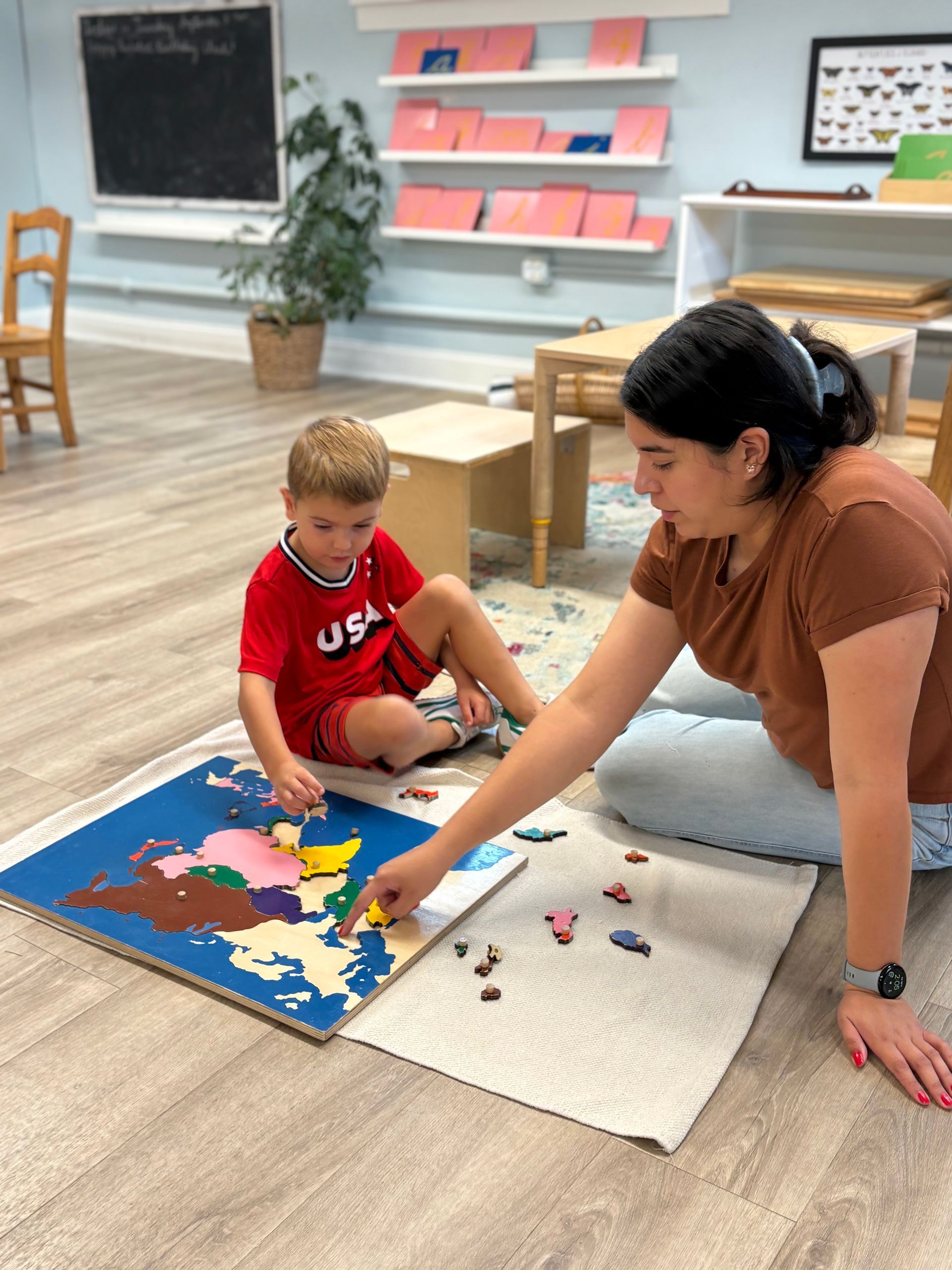
Have you ever wondered how your young child seems to learn complex skills without any formal instruction? One day, they are listening to you speak; the next, they are using full sentences with remarkable accuracy. They watch you open a door, and suddenly they are replicating your exact movements with intent.
Dr. Maria Montessori described this extraordinary mental power as the Absorbent Mind—a unique period of cognitive development occurring during the first six years of life.
At West Suburban Montessori School, our environments are specifically designed to honor and nourish this natural superpower, giving children a rich, peaceful space in which to construct themselves.
The Absorbent Mind vs. the Adult Mind
The way a young child learns is fundamentally different from how adults process information. Adults learn through conscious effort: we study, memorize, practice, and evaluate. Children in their first six years, however, absorb knowledge directly from their surroundings, continuously and effortlessly.
During these foundational years, neural plasticity is at its peak. The young child’s mind takes in every aspect of the environment without filter or judgment.
To illustrate this, Dr. Montessori compared the child’s mind to a camera and the adult’s to a painter:
- The Adult Mind (The Painter): Selects what to focus on, filters out irrelevant background noise, and interprets the scene before painting.
- The Child’s Mind (The Camera): Takes in the entire scene instantly. Every detail—the beautiful and the organized, as well as the chaotic or loud—is captured on the film.
The impressions absorbed during this stage do not merely sit in the child’s memory; they become part of who the child is.
"Adults admire their environment; they can remember it and think about it; but the child absorbs it. The things he sees are not just remembered; they form part of his soul." — Dr. Maria Montessori, The Absorbent Mind
Key Characteristics of the Absorbent Mind
This biological window of effortless absorption naturally fades around age six. During these early years at WSMS, we pay close attention to the defining characteristics of this phase:
- Totality of Impressions: Children absorb not just physical objects, but the emotional climate, social grace, tone of voice, and subtle routines of the classroom and home.
- Guided by Sensitive Periods: Children pass through special developmental windows where they are irresistibly drawn to specific skills—such as language acquisition, spatial order, fine motor control, and social harmony.
- Effortless Adaptation: Through absorption, children effortlessly adapt to their specific culture, family, and community, acquiring language and social norms organically.
The Two Developmental Phases
Montessori observed that the Absorbent Mind unfolds in two distinct stages:
1. The Unconscious Absorbent Mind (Birth to Age 3)
In the toddler years, children take in impressions unconsciously. Guided by their inner drive to move, touch, and explore, they are laying the bedrock for speech, coordination, and trust. You can focus on creating a calm, predictable, and language-rich space where young children feel secure as they build their foundational abilities.
2. The Conscious Absorbent Mind (Ages 3 to 6)
In our Primary environments, children enter a phase of conscious organization. Having effortlessly absorbed vast amounts of information in their first three years, they now possess a strong desire to categorize, order, and understand those impressions.
This is where Montessori materials—such as the Sensorial apparatus, Practical Life tasks, and Sandpaper Letters—play an essential role. They allow the 3- to 6-year-old to classify their world through purposeful hands-on activity, strengthening their focus, memory, and independent will.
Supporting the Absorbent Mind at Home
Because young children absorb their surroundings so completely, the quality of their home environment matters just as much as their school classroom. Here are four simple ways to align your home with your child’s natural learning process:
- Maintain Environmental Order: Keep toys and belongings organized on low, accessible shelves with a dedicated spot for everything. Predictability in the home helps children build internal mental order.
- Offer Rich, Intentional Language: Speak clearly, use expansive vocabulary, and avoid baby talk. The language, inflection, and respect you offer become the foundation for your child's inner voice.
- Invite Meaningful Participation: Allow your child to participate in daily practical life—pouring their own water, wiping a spill, folding laundry, or hanging up their coat.
- Mind the Emotional Atmosphere: Children absorb the emotional tone of a room just as readily as spoken words. Cultivating a calm, patient atmosphere at home provides a sense of emotional security.
Experiencing the Prepared Environment
At West Suburban Montessori School, every shelf, material, and peaceful routine in our environments is intentionally prepared to serve the child's absorbent mind. By providing rich sensory experiences, freedom of choice within boundaries, and respectful social interactions, we help children turn their innate curiosity into lifelong confidence and independence.
We invite you to come see for yourself.
Schedule a tour today!