A common misconception about Montessori education is that it is entirely child-led or unstructured. This could not be further from the reality of a Montessori classroom. While children certainly feel like they are in the driver’s seat of their own learning—and that sense of agency is by design—there is a vast, intentional architecture behind every single day.
Behind the scenes, our Montessori-trained guides are skillfully leading children through carefully sequenced, individualized lessons. They ensure every student encounters, practices, and masters essential concepts across all academic domains.
The true beauty of the Montessori approach at West Suburban Montessori School is how seamlessly it blends two essential elements of real learning: explicit direct instruction and deep, hands-on application.
In traditional education, these two methods are often pitted against one another. In our environments, they work in complete harmony, tailored precisely to the developmental readiness of each child. In many ways, every student at WSMS benefits from an individualized learning path natively built into the Montessori model.
Direct Instruction: Intentional, Precision Teaching
Direct instruction in a Montessori environment looks quite different from a traditional teacher standing in front of a full classroom at a whiteboard. At WSMS, our guides deliver highly focused, step-by-step presentations primarily one-on-one or in small, flexible groups.
This explicit instruction serves a clear purpose:
- Clear Skill Introduction: When a child is ready for a new concept—whether it is letter-sound correspondence in Primary or multi-digit division in Lower Elementary—the guide gives a clear, precise lesson using specific sensory or physical materials.
- Immediate Feedback: Working closely with a guide allows for real-time observation. Guides can offer gentle adjustments on the spot, preventing frustration and building immediate confidence.
- Sequential Progression: Lessons are presented in a logical, developmental sequence. Each new skill builds directly on the foundation of the previous work, ensuring children are neither bored by repetition nor overwhelmed by premature difficulty.
This structured framework provides clarity and security. Children always know how to handle materials with care and purpose, setting them up for success when they transition to independent work.
Hands-On Learning: Concrete Understanding Before Abstract Work
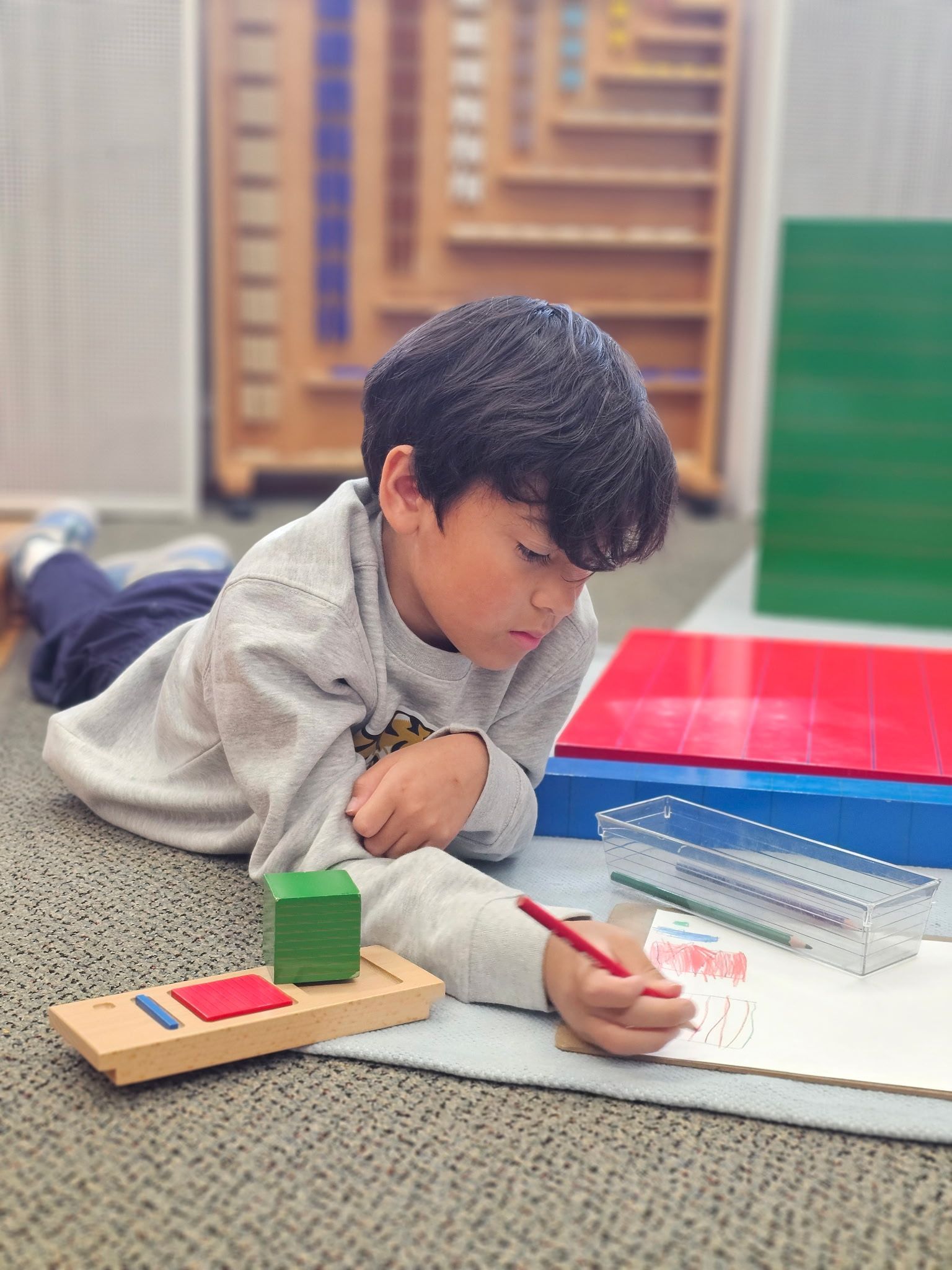
Once a guide presents a direct lesson, the child transitions into the hands-on phase of learning. Instead of passively completing a worksheet, the student engages deeply with tactile, self-correcting materials designed to make abstract concepts concrete.
In our Primary and Elementary environments, learning is experienced through action:
- Tactile Engagement: Children do not just read about geometry or place value; they build geometric solids, trace sandpaper letters, and manipulate golden bead material representing units, tens, hundreds, and thousands.
- Deep Neural Connections: Research consistently shows that kinetic, hands-on learning builds stronger neural connections. When children engage their hands alongside their minds, retention and conceptual understanding skyrocket.
- Problem-Solving and Resilience: Montessori materials are designed with a "control of error." This means the material itself often reveals when a mistake has been made, encouraging the child to analyze, adjust, and try again independently without needing constant adult intervention.
The Best of Both Worlds in Practice
What makes the WSMS experience so effective is how these two phases continuously feed into one another.
A student might receive a ten-minute explicit lesson from their guide on a new grammar concept in the morning. For the remainder of the week, that child has the freedom to select that work, collaborate with a peer, apply the concept across different sentences, and practice until they reach true mastery.
Our guides provide the roadmap and the foundational instruction; the children are given the time, space, and beautiful materials needed to internalize the knowledge at their own pace.
The result is a classroom community alive with joyful focus. Our students do not simply memorize facts for a test—they develop a profound, lasting understanding of how the world works. They leave WSMS as confident, curious, and self-directed learners who know both the satisfaction of personal discovery and the security of expert guidance.
Come see our joyful, bustling communities. We invite you to
schedule a tour.