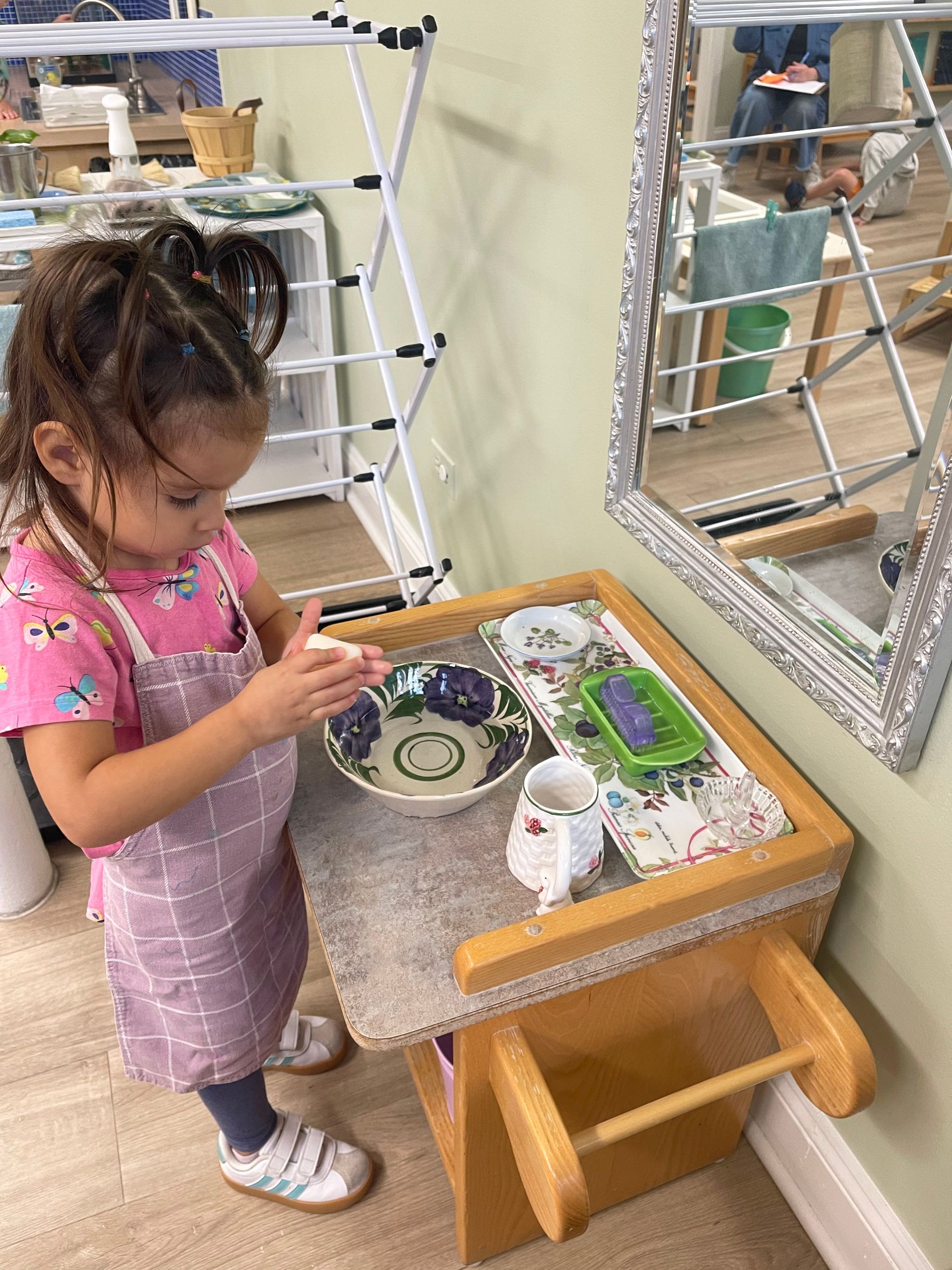
If you step into a Primary environment at West Suburban Montessori School, you might notice something that surprises you: a beautifully arranged, child-sized hand-washing table complete with a ceramic pitcher, a small basin, a bar of soap, a bucket, and small drying cloths.
A natural question many parents ask is: Why do Montessori classrooms have a hand-washing basin and pitcher when children could just use a modern sink? Isn’t this an antiquated experience?
To understand the value of this beautiful exercise, it helps to step back and explore why young children are so deeply drawn to this elaborate process, the immense developmental benefits of breaking an activity down into sequential steps, and what our students are truly accomplishing through the experience.
The True Foundation of Practical Life
In a Montessori, activities like washing a table, polishing silver, or washing hands are categorized as Practical Life. These exercises provide the absolute foundation for our Primary programs.
Because these activities look like daily household chores, they often don't receive the appreciation they deserve—especially when compared to the obvious academic nature of the Montessori math or language materials. However, Dr. Maria Montessori discovered over a century ago that these simple, real-world tasks are precisely what unlock a young child's ultimate developmental potential.
A Beautifully Unexpected Discovery
The very first exercises of practical life began out of pure necessity in Dr. Montessori’s original classroom in Rome. Observing that the young children in her care needed foundational lessons in hygiene, she provided simple water basins and cakes of soap, showing them how to wash their hands and faces.
What happened next was entirely unexpected. Once the children finished washing, they didn’t stop. They repeated the activity over and over, long after their skin was perfectly clean.
Dr. Montessori observed that the children were driven by an inner developmental need. Instead of stopping them to save time or avoid a mess—as adults are often tempted to do—she watched with scientific curiosity. What she discovered changed the way we view early childhood education forever.
The Deeper Purpose: The Work of Self-Construction
Dr. Montessori identified a fundamental difference between how adults experience work and how young children experience it. For an adult, work is a means to an end; we wash our hands to get them clean as quickly as possible so we can move on to the next task.
For a child under the age of six, work is an energizing process of self-construction. Children are intrinsically motivated to interact with their environment to build their intelligence, concentration, coordination, and independence.
Adults often interrupt this vital urge because the action seems too complicated, too messy, or inefficient. In our prepared environments at WSMS, however, we intentionally offer exact motives of activity that match these deep developmental needs.
The Interlocking Benefits of the Hand-Washing Ritual
In addition to using our classroom sinks for a quick rinse before lunch, the dedicated hand-washing station remains one of the most beloved areas in our environments. The process is broken down into precise, logical steps:
- Gross Motor Coordination: Filling a small pitcher with the exact right amount of water, carefully carrying it without spilling, and pouring it into the basin requires immense physical control. When children carry the heavy bucket of dirty water back to the sink to empty it, they practice crucial gross motor skills that support physical equilibrium and crossing the midline.
- Fine Motor Refinement: Lathering a small bar of soap, working up a foam, and meticulously cleaning the fronts, backs, and wrists of each hand refines visual-motor coordination and builds the finger strength necessary for future pencil grip.
- A Cognitive Sense of Order: The hand-washing exercise requires a strict logical sequence—from putting on an apron and fetching water to drying the hands, wiping down the table, and restocking clean cloths for the next classmate. This sequencing directly lays the cognitive foundation for the step-by-step processes found in advanced Montessori math and language work.
A Pure Love for the Process
Our students love this care-of-self activity because it allows them to access and use water in a purposeful, dignified way. A child will often remain at the hand-washing table for an extended period, deeply focused on the lather of the soap or the exactness of drying any small drips on the table.
As a child masters these steps, our guides introduce subtle new challenges to sustain their interest, such as using a delicate nail brush or applying a small drop of lotion once their hands are dry.
Far from being an outdated chore, the hand-washing basin is a masterpiece of early childhood development. The entire process is a joy to observe. We invite you to look closely for it during your
next classroom observation to see firsthand how our students utilize this beautiful ritual to build focus, coordination, and independence.