Handwriting instruction is disappearing in schools across the United States.
You may have already heard about this shift. While it is certainly not true for every traditional school, a growing number of programs have set aside explicit handwriting instruction to make room for tech-focused or standardized test-driven skills. The result? A generation of children missing out on the developmental benefits of penmanship, often unable to comfortably read or write cursive.
If that gives you pause, there is good news: people are speaking up, and the educational community is beginning to recognize what was lost. The even better news? At West Suburban Montessori School, we never dropped handwriting in the first place.
For over a century, the Montessori approach has recognized that handwriting is not an isolated mechanical task—it is a deeply cognitive, sensorimotor process. Here is how our guides prepare children at WSMS to write with confidence, comfort, and pride.
Indirect Preparation: Building the Hand Before the Pencil
Walk into a WSMS Toddler or Primary environment, and you will see children as young as two and three deeply engaged in activities that look like play. Beneath the surface, these tasks are carefully structured Practical Life and Sensorial works designed to indirectly prepare the hand for writing.
- The Pincer Grip: Every time a three-year-old carefully lifts a Knobbed Cylinder by its tiny wooden peg, they are strengthening the exact three-finger grip needed to hold a pencil.
- Hand Strength and Wrist Mobility: Activities like pouring water, scrubbing tables, using tweezers, and squeezing sponges build hand stamina and wrist control naturally.
- Left-to-Right Orientation: In our environments, shelf materials are organized sequentially from left to right. When a guide presents a work, they move their hands from left to right. Before a child ever picks up a pencil, their eye and brain are already accustomed to the visual tracking required for reading and writing.
Manipulating the Pencil: The Metal Insets
Long before they are asked to write words or construct sentences, children in our Primary environments learn how to control a pencil with grace and lightness.
One of the foundational materials for this is the Metal Insets. While these geometric shapes may look like an early math lesson, their primary purpose is handwriting preparation. Children trace the metal shapes, carefully shade the interiors using parallel lines, and experiment with pressure and stroke control.
Through this joyful, creative exercise, children build muscle memory, learn to apply the appropriate amount of pressure, and develop the hand stamina necessary to write without fatigue.
Early Letter Formation: Sensorial Engagement
When children are ready to learn letter shapes, we do not hand them a worksheet. Instead, we engage their senses through tactile, hands-on materials:
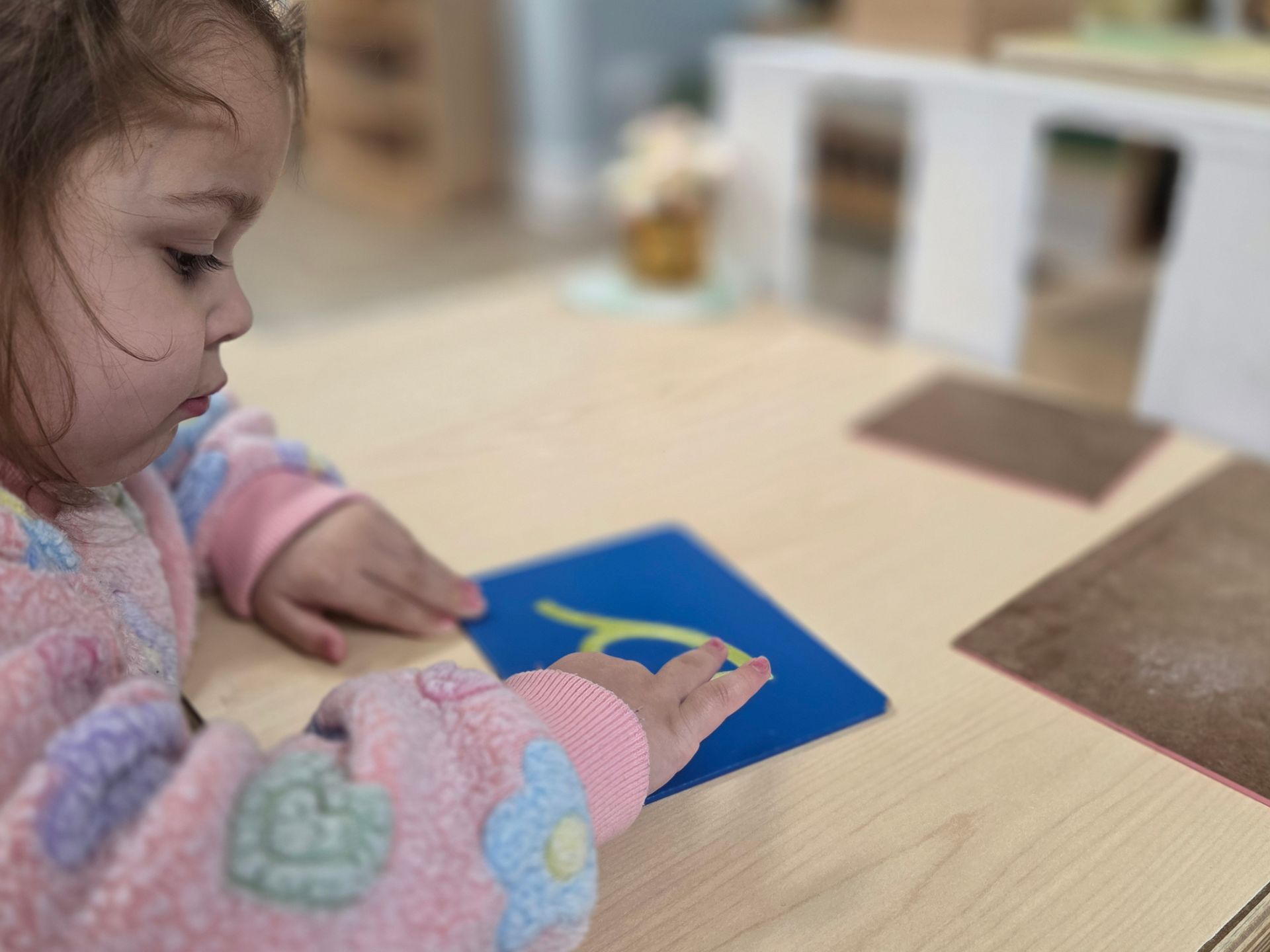
- Sandpaper Letters: Wooden tiles featuring letters cut from textured sandpaper. The child traces the rough letter with their index and middle fingers while saying the phonetic sound aloud. This ties the muscle memory of the hand directly to the visual shape and auditory sound.
- Sand Trays: Children practice tracing letter forms in a low wooden tray lined with fine sand. It offers an inviting, low-pressure way to practice stroke order—if a child wants to try again, a gentle shake of the tray creates a fresh slate.
Why Cursive First?
At WSMS, children typically begin their writing journey in cursive rather than manuscript (print). While this often surprises parents, it is a deliberate, highly beneficial choice:
- Prevents Letter Reversals: Common print mix-ups like b and d or p and q are virtually non-existent in cursive because each letter starts with a distinct fluid stroke.
- Continuous Movement: Cursive follows the natural, fluid motion of a young child's hand. Print requires constant stopping, lifting, and repositioning of the pencil, which can be frustrating for a developing hand.
- Word Unity: Because letters connect naturally, children visually and physically grasp where one word ends and the next begins. The ligatures aid early readers in recognizing common letter blends (th, ing, oa).
- Natural Transition to Reading: Children who learn cursive can read both cursive and print with ease. The reverse is rarely true for children taught only print.
The Elementary Continuation
When students transition into our Lower Elementary environment, their guides build directly on these foundational skills.
Elementary children use their handwriting daily as an essential tool for expression and organization. They record observations in science journals, draft original stories, log their daily work plans, and craft research reports. Because the physical act of writing was thoroughly refined in Primary, our elementary students do not struggle with pencil fatigue. Instead, they take immense pride in the beauty and clarity of their work.
While modern tools like keyboarding are introduced at the appropriate developmental stage, they build upon a foundation that values craftsmanship, focus, and patience. In a fast-paced world of quick taps and voice notes, our students retain the timeless ability to sit down and craft a beautiful, legible, and thoughtful handwritten page.
Schedule a tour today to see handwriting preparation in practice!