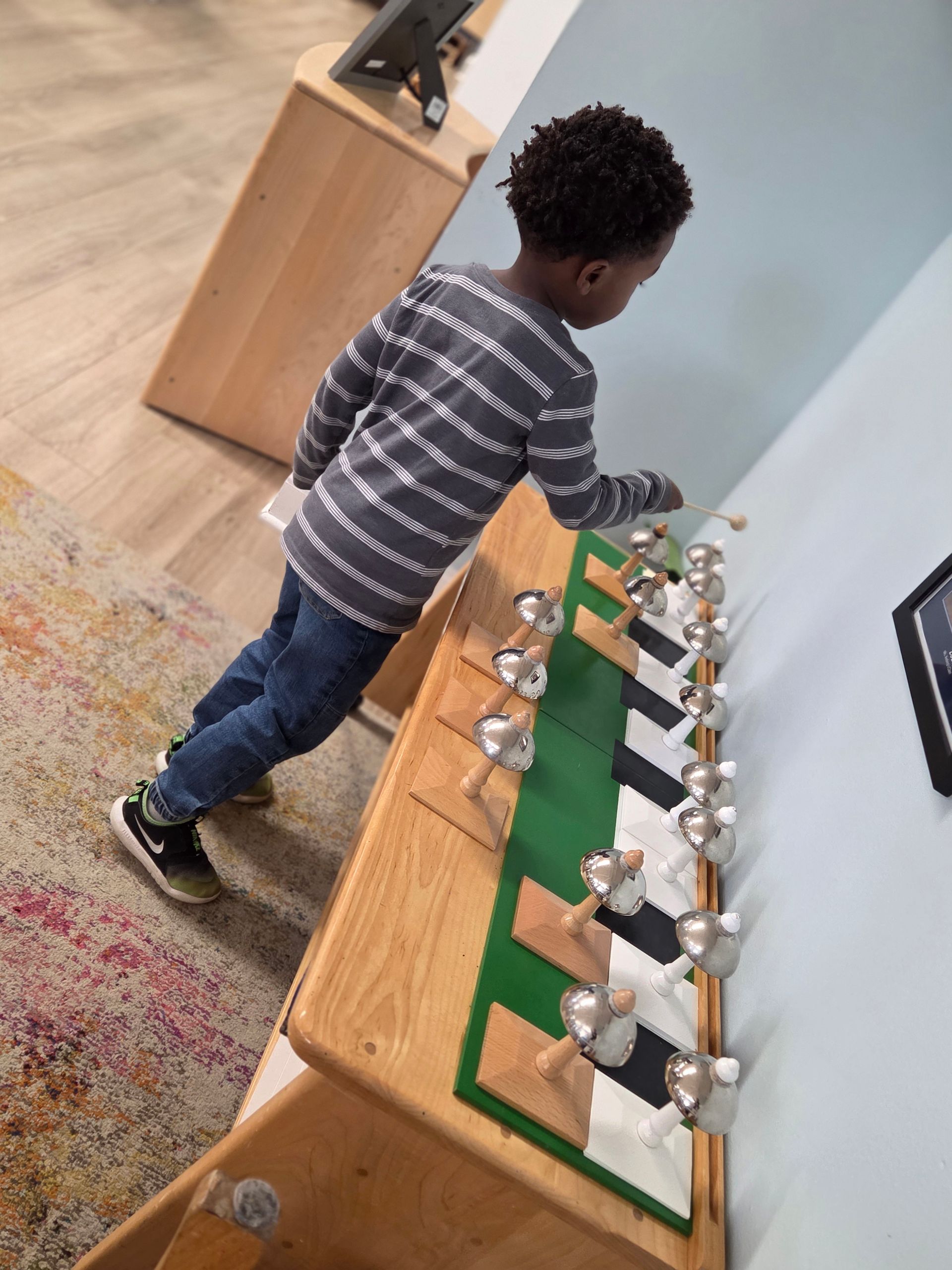
In order to be truly free, we must be able to make our own choices—and possess the practical skills to act upon those choices. Without independence, true freedom isn't possible.
Dr. Maria Montessori recognized that as a child's independence grows, so does their capacity for meaningful freedom. In our prepared environments at West Suburban Montessori School, the freedoms children experience are directly linked to their developing independence. Over their years in the classroom, children build mastery over their environment, becoming confident, self-directed learners who serve as inspiring role models for their younger peers.
To foster this natural progression, our guides carefully safeguard five core freedoms within the daily work cycle:
1. The Freedom to Choose Purposeful Work
Even at a young age, children have clear ideas about what captures their interest. In our classrooms, we support this emerging autonomy by offering real choices—though it is far from a free-for-all!
Our environments are thoughtfully prepared with sequential materials designed to meet specific developmental needs. A child is free to choose any material they have been introduced to by a guide or that they have the capability to work with independently.
For our youngest children, we build this decision-making skill in simple, concrete steps. When introducing a multi-step activity, a guide might ask: "Would you like to carry the tray or the basket to your table?" Over time, children learn to navigate increasingly complex choices, laying the groundwork for self-directed study in their Elementary years.
2. The Freedom to Work Without Interruption
Once a child chooses an activity, they are free to engage with it for as long as their interest holds, without unsolicited interference from adults or peers. Protecting this deep focus is one of the guide's most vital responsibilities.
Montessori materials are inherently self-correcting, allowing children to identify and solve errors independently without relying on an adult for constant validation. Whether a three-year-old is meticulously washing a table or an older student is solving a complex math problem, we guard their concentration fiercely. When children are frequently interrupted, their focus fragments; when their focus is respected, they feel safe taking on new academic and personal challenges.
3. The Freedom of Movement
Movement and cognition are deeply intertwined. Rather than sitting at assigned desks for hours, WSMS students have the liberty to move naturally throughout the classroom.
Children choose whether to work at a table or on a work rug on the floor. They can stand, stretch, get a glass of water, or use the restroom when their body tells them to. During group gatherings, children are invited to participate, learning to listen to their own internal rhythms while respecting the collective group.
4. The Freedom to Communicate Respectfully
Communication is a natural, healthy part of a social learning community. Children in our environments have the freedom to converse and collaborate with peers, provided it does not disturb their own work or the work of others.
Because we view communication as a gift rather than something to be suppressed, guides model respectful dialogue. When a child approaches an adult to share an observation, we make it a priority to give them our full attention and grace.
5. The Freedom to Work at Their Own Pace
Unlike traditional classrooms where every student moves through the same lesson at the exact same minute, Montessori children follow an individualized pace. Our daily schedule is built around long, uninterrupted work cycles, giving children the time they need to immerse themselves deeply in their chosen work.
Children are free to repeat an exercise as many times as they wish. Repetition is how young minds internalize concepts and master skills. When a child is new to the classroom, we often gently remind them: "You may work with this for as long as you like."
The Balance: Freedom Within Limits
To support this foundation of freedom, every Montessori environment relies on clear, consistent boundaries. Freedom without limits leads to chaos; limits without freedom lead to passivity.
In our classrooms, a few fundamental ground rules protect the community:
- Availability: A material on the shelf is available for anyone who has had the lesson. If a material is on a classmate's rug, it is currently unavailable.
- Care of Community: Children learn that taking a material from the shelf carries the responsibility of restoring it fully for the next person. This means drying off a wet tray, sharpening a pencil, or carefully returning every piece to its proper place on the shelf.
Nurturing Confident, Capable Learners
As children gain practical skills, their independence expands—and with it, their choices. By balancing freedom with meaningful responsibility, we help children develop real self-discipline, resilience, and a lifelong love of learning.
We invite you to
schedule a classroom observation to see independence in action.