At the heart of West Suburban Montessori School is a profound, non-negotiable respect for human potential. The historical core of our philosophy and daily practice originated when Dr. Maria Montessori, as part of her pioneering medical training, began working with children who had significant developmental delays.
Where others saw limitations, Dr. Montessori saw untapped potential. By observing what the children truly needed, she designed specialized materials and a physical environment structured to support their natural development. The result was remarkable, groundbreaking growth that forever changed our global understanding of childhood, learning, and the human experience.
A Scientific Lens on Human Nature
Dr. Montessori did not approach education through a lens of traditional academic schooling; she approached it as a scientist. Through years of rigorous observation, she recognized that humans possess innate, universal characteristics and follow highly predictable patterns of physical and psychological development. At our core, we are a species beautifully designed to learn, to adapt, and to thrive.
By observing children across different cultures and socio-economic realities, she identified distinct stages of growth—which we refer to as the Planes of Development—alongside a set of universal Human Tendencies that drive learning and adaptation from birth to maturity. These tendencies are not random behaviors. They are powerful, evolutionary forces that guide children to meet their developmental needs and fulfill their individual potential.
Aligning Classroom Environments with Nature
At WSMS, our entire curriculum is structured around supporting these natural stages and tendencies. Instead of imposing arbitrary learning objectives on a rigid schedule, we respect and reinforce the natural unfolding of each child’s distinct abilities.
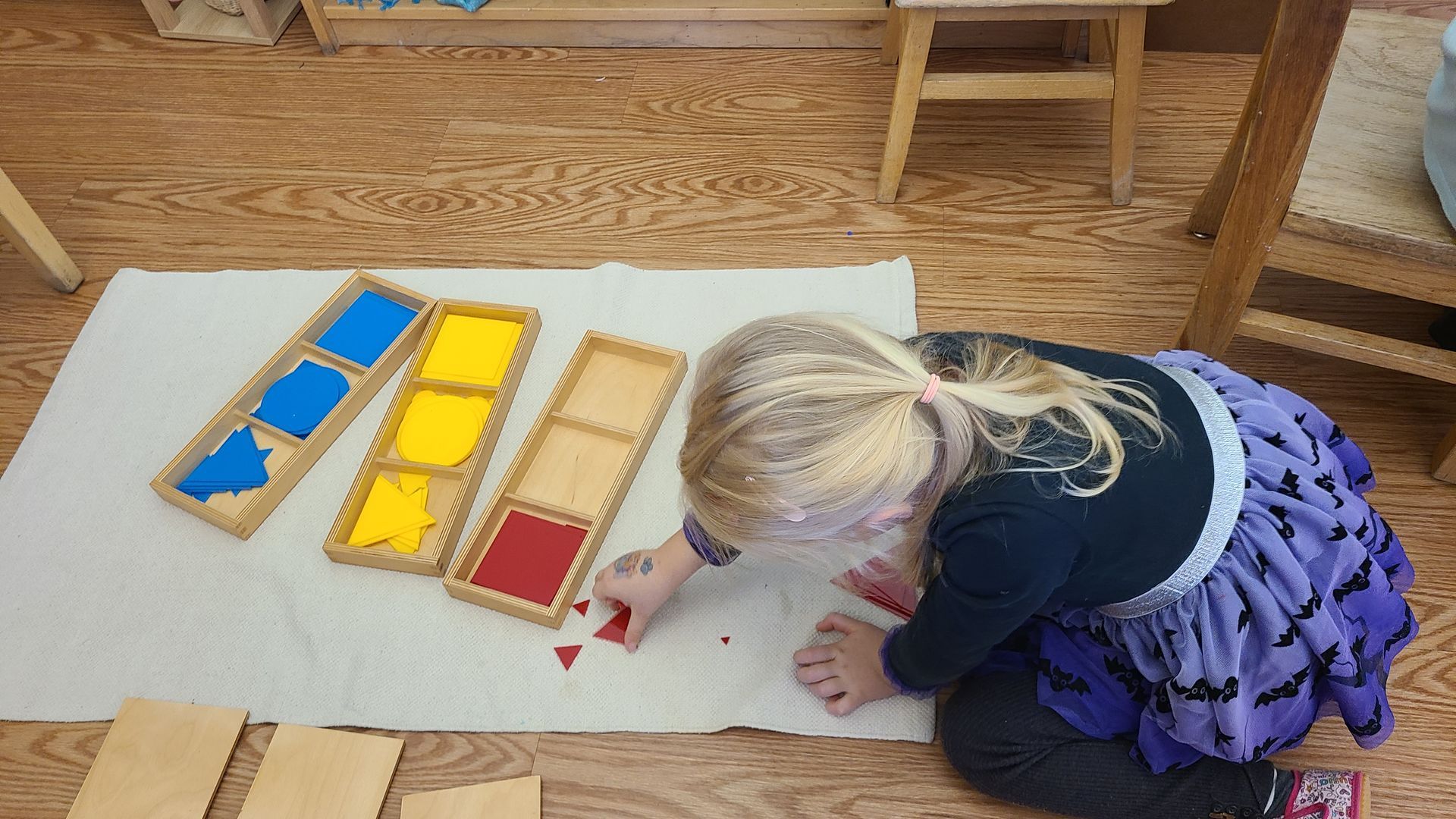
Our Primary and Elementary environments are meticulously prepared by trained Montessori guides to meet specific developmental needs. In this setting, the adult's role gracefully shifts from the traditional "teacher" who lectures at the front of a room to an aid to life. Our guides observe closely, prepare the environment with care, and gently connect the child to the materials, allowing the child to lead their own discovery.
A Cosmic Perspective on Education
Dr. Montessori’s vision went far beyond individual academic success. She viewed human beings as an intrinsic part of a vast cosmic web of interrelationships. In this interconnected system, every organism plays a vital role in maintaining ecological and social balance.
With this perspective, education at WSMS must cultivate more than just intellect; it must cultivate humility, wonder, and deep global stewardship.
This is particularly evident in our Elementary curriculum, where children study history, geography, and science through a unified lens. In this context, learning is not about passing a test or achieving status; it is about supporting the growth of mature, adaptive, and deeply aware human beings who understand their responsibility to the world around them.
The Power of Human Adaptation
Humans are uniquely capable of adapting to a vast range of environments, cultures, and social conditions. From birth, a child adapts and evolves through direct, tactile interaction with their surroundings. Through their senses, their hands, their minds, and their classroom relationships, our students actively construct themselves and their unique understanding of the world.
Dr. Montessori identified key physical and psychological characteristics that support this adaptation. Humans experience a long, protected childhood, noteworthy for the synchronized development of our hands, our intelligence, our imagination, and our social interdependence. These capacities are guided by the innate Human Tendencies, which include the drive to:
- Orient to the immediate environment
- Explore the unknown
- Order and make sense of the world
- Abstract and think symbolically
- Imagine possibilities beyond current reality
- Calculate and reason logically
- Work to shape and adapt the environment
- Repeat and strive for precision
- Perfect oneself through joyful effort
- Communicate and associate with others
These tendencies are lifelong and evolutionary. They cannot be turned off, but they can be supported—or thwarted. When these drives are blocked by rigid restrictions or unnatural expectations, children will still find a way to meet their inner needs, often resulting in behavioral friction or frustration.
Look Beneath the Behavior
To truly support our students, the guides at WSMS practice the art of careful observation. We strive to look beneath surface behaviors to understand which internal tendency is seeking expression. This observational practice shifts our perspective from managing behavior to honoring a natural developmental process.
Our daily work challenges traditional, top-down views of education. Instead of viewing the adult as the primary source of knowledge, we recognize that children are self-constructing beings.
When we align our school environments with the true science of human development, we open the door to profound potential. Montessori education at WSMS offers a visionary framework rooted in science, observation, and a deep reverence for what it means to grow. It calls us to see our children not as empty vessels to be filled, but as human beings full of infinite possibility, ready to become compassionate, capable citizens of our world. We invite you to schedule a tour to see this in action.